Light for viewing
Fish do not need strong light. A basic LED that shows color well and runs on a timer is enough. Extra light mostly grows algae.
Light does a different job in each kind of tank. Fish-only tanks need it for viewing and a day-night rhythm, planted tanks need it to grow, and reef corals use it as food. In every tank, a steady schedule on a timer matters as much as the fixture.
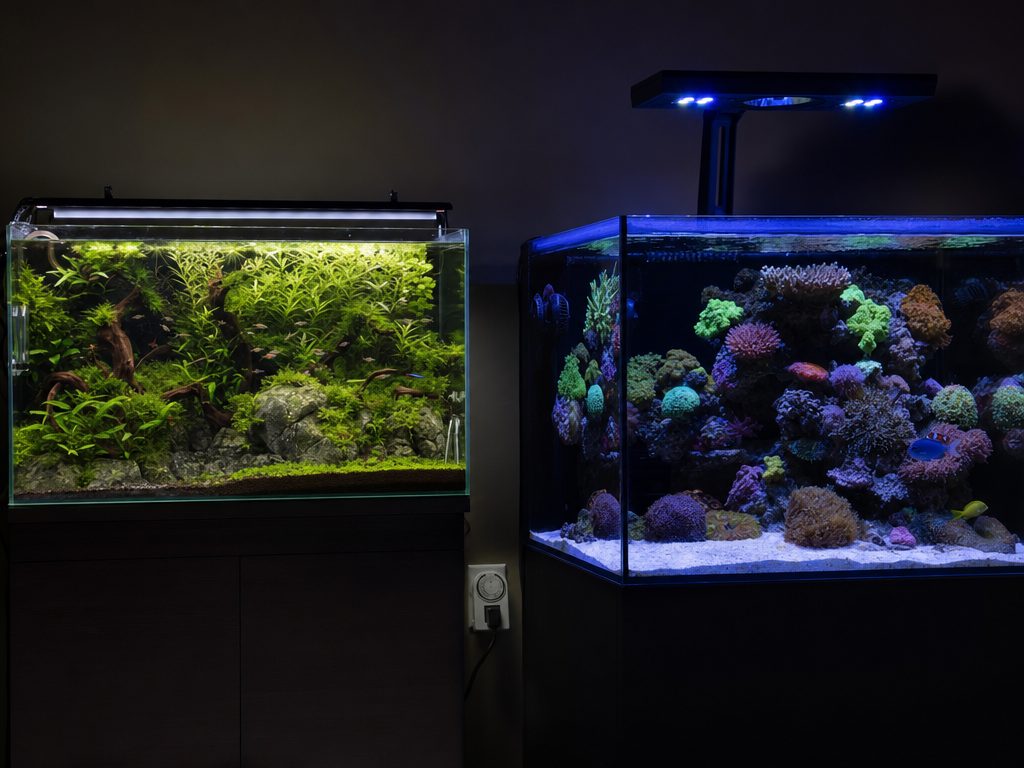
More light is not automatically better. Buy for the plants or corals you keep or plan to keep, not the biggest fixture that fits.
Fish do not need strong light. A basic LED that shows color well and runs on a timer is enough. Extra light mostly grows algae.
Easy low-light plants grow under modest light. Carpeting and red plants need stronger light, plus CO2 and fertilizer, or algae takes over.
Shop CO2Like a freshwater fish-only tank, light is mainly for you and a steady day-night cycle. Reef-strength light only matters once corals are planned.
Most reef corals carry tiny algae in their tissue that turn light into food. Reef lights need a coral-friendly spectrum, usually blue-heavy, and enough strength where corals sit.
Saltwater basicsA fixture close to the tank's length lights it evenly. Light weakens with depth, so tall tanks need more strength to reach the bottom.
How long the light runs each day affects algae as much as how bright it is.
Most tanks do well with roughly 6-10 hours of main light a day. This is a rough guide, not a rule.
A timer keeps the schedule the same every day, even when you are busy or away.
Many LED fixtures can dim up and down. A slow sunrise and sunset is gentler than lights snapping on in a dark room.
Algae grows when light runs ahead of what plants, corals, and nutrients can use.
You do not need to become a lighting expert, but a few ideas prevent most reef lighting problems.
PAR measures the light corals can use at a given spot. It drops with depth and toward the edges of the light's spread.
Soft corals and many LPS generally want less light than most SPS. Ask about a coral's needs when you buy it.
A new or stronger light can bleach corals used to a weaker one. Start well below full power and raise it over several weeks.
Water spots, salt creep, and dusty lenses cut the light that reaches the tank.
Most lighting problems come from too much, too long, or too fast.
Long schedules are a common algae trigger. Cut back toward 6-8 hours and put the light on a timer.
Algae troubleshooterSunlight adds hours you cannot control and can feed green water. Block it or move the tank.
Green water guideNew reef lights and new planted tanks both do better starting dim and short, then increasing over weeks.
Strong light without enough CO2 and nutrients often grows algae instead. Raise light only as plants can use it.
Change intensity, schedule, or coral placement one step at a time so you can tell what helped.
Coral not opening