Salinity
The other readings shift with salinity, so get it right before you judge them.
- Typical target: about 1.025-1.026 SG (35 ppt)
- Check the refractometer with calibration fluid
- Top off with fresh RO/DI water only
Corals use alkalinity, calcium and magnesium as they grow, so those levels slowly fall. Learn why they drop, how to measure what your tank uses, and how to replace it slowly. Test first, change slowly, and keep alkalinity steady.
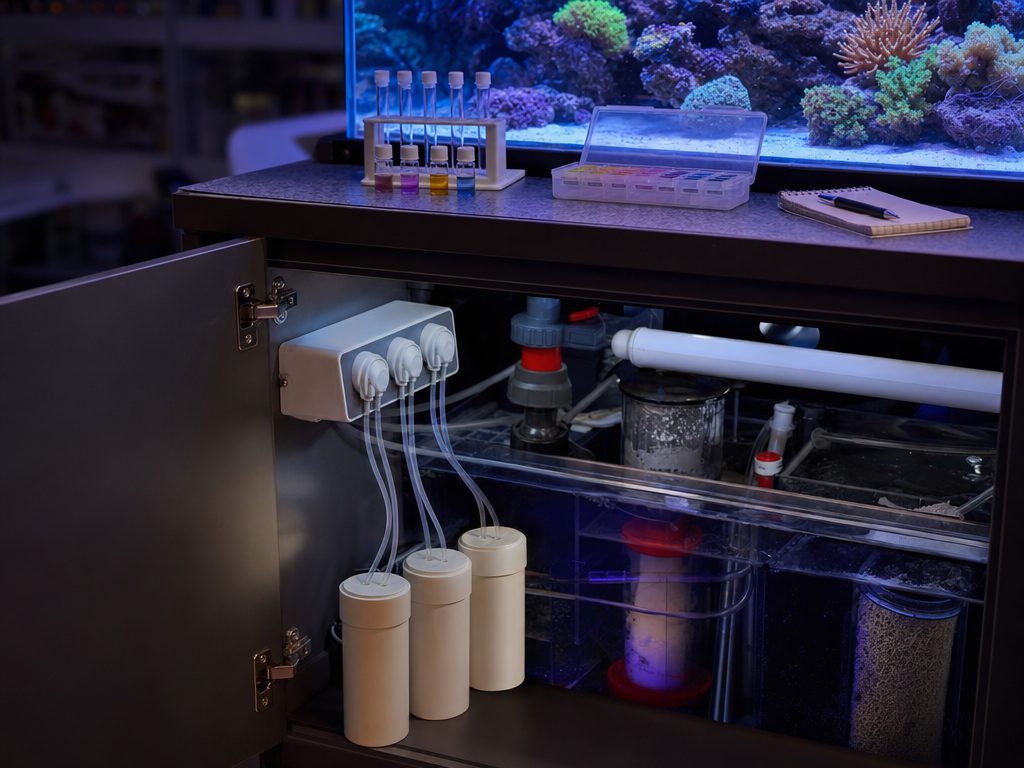
Stony corals, clams and coralline algae build skeletons and shells from these. A mostly soft coral tank may stay balanced with water changes; a growing stony coral tank usually will not. Ranges are typical targets, not rules.
The other readings shift with salinity, so get it right before you judge them.
Corals use it to build skeleton, and it helps hold pH steady. It is usually the first number to fall.
Corals take calcium and alkalinity from the water together, so they tend to fall together.
Magnesium helps keep calcium and alkalinity in solution. When it runs low, the other two are hard to hold.
Dosing replaces what your tank actually uses. You only know that number by testing.
Test salinity, alkalinity, calcium and magnesium on the same day.
Test alkalinity at the same time each day for several days, with no dosing or water changes.
Use the product label to work out what replaces that daily drop, then start slightly below it.
Test alkalinity every day or two at first, then a few times a week once it holds steady.
Start with the simplest method that holds your numbers steady. Move up only when testing shows you need to.
Fresh salt mix contains all three. For soft corals and a few stony corals, regular changes can be enough.
One solution for alkalinity, one for calcium, added on a schedule. Magnesium is added as needed.
A dosing pump adds two-part in small amounts through the day, so levels stay steadier than hand dosing.
CO2 slowly dissolves calcium carbonate media, adding alkalinity and calcium in a natural balance.
Supplements are concentrated. Too much, too fast or in the wrong spot can hurt corals more than a slightly low reading.
If the water turns milky after a dose, stop dosing, keep the flow running and retest before adding anything else.