Look, then test
Test before the water change so results show how the tank is really doing.
- Note closed corals, new algae, pests or missing fish
- Test salinity and alkalinity, plus any tests due
- Write each result next to the date
A reef stays healthy through small, steady habits. Look the tank over every day, test the numbers that move fastest each week, and change water with saltwater that already matches the tank. Most reef trouble starts with a swing, not one bad number.
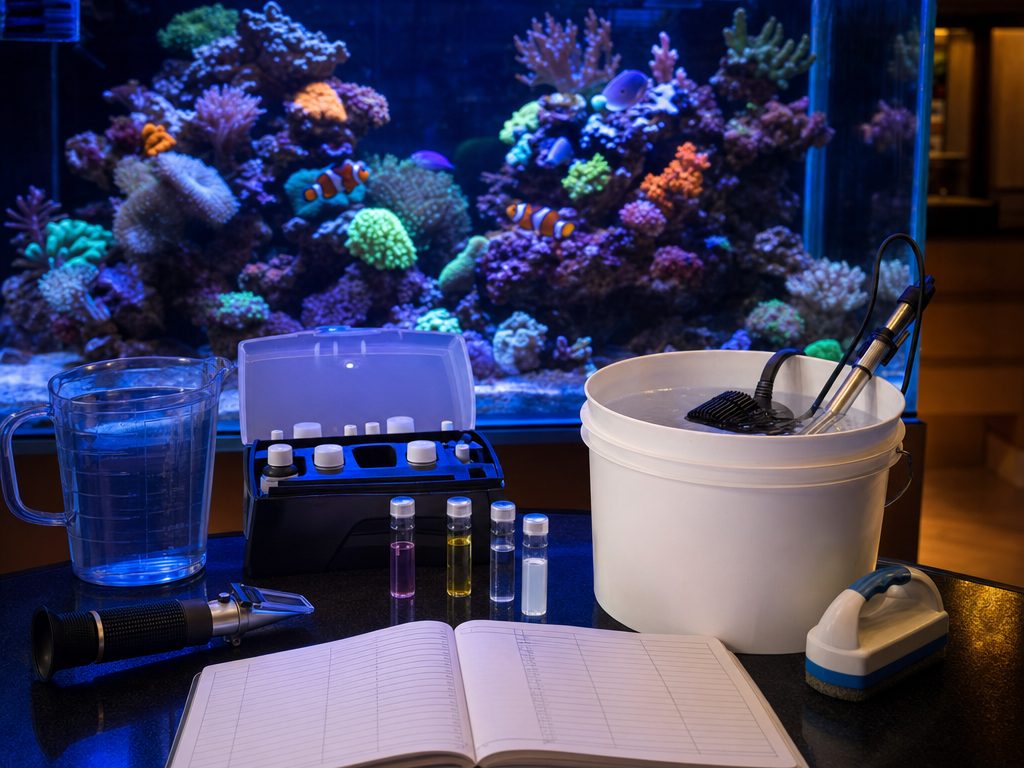
A starting schedule. Tanks with many stony corals, or tanks you dose, need closer testing.
| Task | Why it matters |
|---|---|
| Every day | |
| Look over fish, corals and equipment | Two minutes catches a closed coral, a missing fish, a stopped pump or a drip early. |
| Check temperature and top-off water | Steady matters more than exact (many reefs run about 76-80°F). Salt stays behind when water evaporates, so salinity climbs if top-off runs out. |
| Every week (or two) | |
| Test salinity and alkalinity | These move fastest. Typical targets: salinity about 1.025-1.026 SG (35 ppt), alkalinity about 7-11 dKH and held steady. Test more often if you dose. |
| Water change with pre-mixed saltwater | Dilutes nitrate, phosphate and waste, and replaces some of what corals use. Many reefers change about 10-20% every one to two weeks. |
| Empty the skimmer cup, change filter socks | Trapped waste keeps breaking down until it leaves. Do this every few days to weekly. On a fleece roller, check the roll and sensor. |
| Clean the glass | As needed. Keeps light reaching corals and makes pests easier to spot. |
| Every two to four weeks | |
| Test calcium, magnesium, nitrate and phosphate | Slower movers. Typical targets: calcium about 380-450 ppm, magnesium about 1250-1400 ppm. Watch nitrate and phosphate trends; very high and bottomed-out readings both cause trouble. |
| Check the refractometer | Use 35 ppt calibration fluid. A drifting refractometer is wrong every time you use it. |
| Wipe salt creep, check RO/DI water | Salt creep damages lights and cords. A TDS meter shows when DI resin is spent. |
| Every few months | |
| Clean pumps, wavemakers and the skimmer | Mineral buildup slowly chokes flow. Soak parts in vinegar and water or an aquarium pump cleaner, then rinse well. |
Test first, do the messy jobs next, then change water so loosened debris leaves the tank.
Test before the water change so results show how the tank is really doing.
Do this first so the loosened debris gets siphoned out.
Use saltwater mixed ahead with RO/DI water and fully dissolved. Never add salt mix straight to the tank.
Confirm everything runs before you walk away.
Keep aquarium tools separate. Soap and household sprays do not belong near a reef.
Corals handle a steady, slightly imperfect number better than a fast swing toward a perfect one. Change one thing at a time and give the tank a few days to respond.