Water drains onto fleece
Overflow water lands on a sheet of fleece stretched across a roller, and the fleece traps fine particles.
A fleece roller is an automatic mechanical filter for a sump. Water passes through a sheet of filter fleece, and when the fleece clogs, a motor rolls fresh fleece into place and winds the dirty section out of the way. You will mostly see them on saltwater and reef sumps.
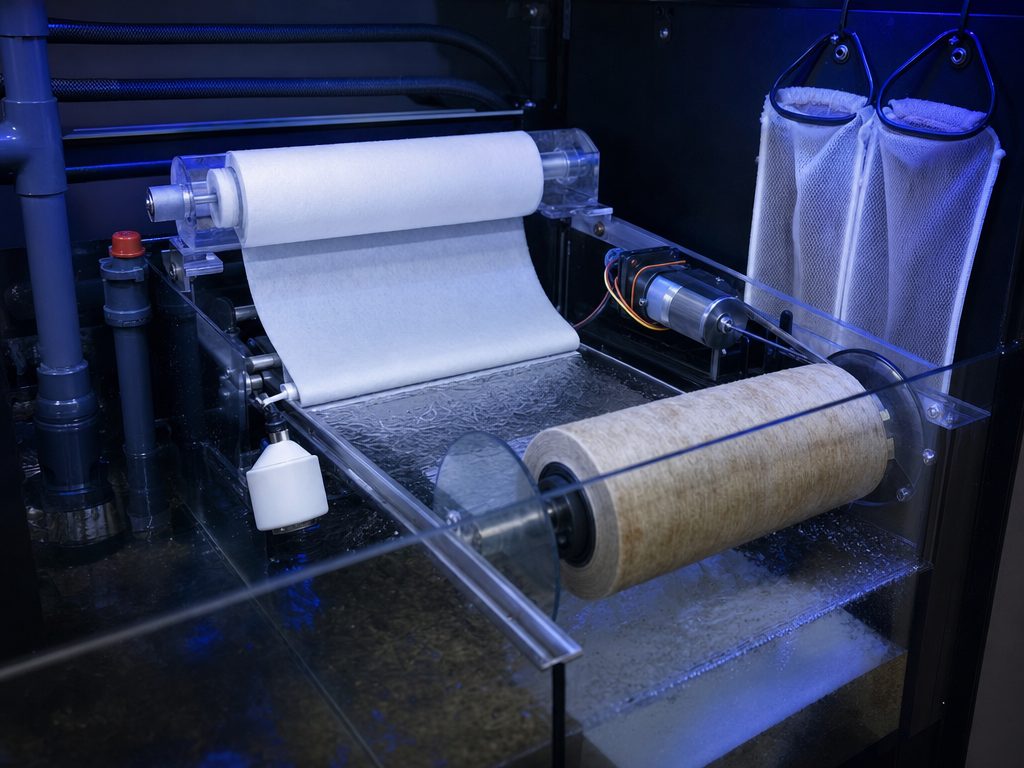
It sits where the overflow drains into the sump and catches particles before the water reaches the rest of the system.
Overflow water lands on a sheet of fleece stretched across a roller, and the fleece traps fine particles.
As debris builds up, water passes through more slowly and the level behind the fleece rises.
A float or level sensor notices the rise and tells the motor to advance the fleece.
Fresh fleece comes off the supply spool while the dirty section winds onto the take-up spool, out of the main flow.
All three catch debris. The difference is how often you have to touch them and how long the waste sits in the water.
Socks catch debris well but need swapping every few days. A full sock overflows or bypasses, and trapped waste keeps breaking down in the water.
Sponges hold a lot of debris and can be rinsed, but they still need regular cleaning and collect waste between services.
Filter media guideFresh fleece stays in the flow and dirty fleece is wound out of the way on its own. You mainly change rolls and check the parts.
Rollers save a lot of routine work, but they take space and still need care.
Fleece traps fine particles, including coral food. Many keepers pause the return pump while feeding so food stays in the display longer.
A roller removes solid waste before it rots into nitrate and phosphate. It does not remove dissolved waste, so a skimmer, water changes, and testing still matter.
Measure before you shop. Check the manufacturer's dimensions and flow rating against your own numbers.
Note the filter section's width, length, and height, the water level there, and room above for the motor, spools, and your hands.
Pick a roller rated above what your return pump actually delivers after head loss, so it is not advancing constantly.
Pumps and flowOverflow drains need to land in the roller inlet. Note how many drains you have and their size.
Plumbing partsCompact rollers are made for some all-in-one tanks and small sumps. Confirm the model fits your rear chamber.
Rollers work on freshwater sumps too, but most freshwater tanks use canister or hang-on-back filters.
Automatic does not mean maintenance-free. A quick look most days catches problems early.
See that the fleece advances normally and how much is left.
A stuck float can make the roller run nonstop, or never advance so water bypasses the fleece.
When the roll runs out, unplug the unit, remove the full take-up spool, and thread a new roll the same way.
Look over the gears, rollers, and motor housing during regular maintenance.
Most roller problems trace back to sizing, a dirty sensor, or expecting it to do every job.
A roll that runs out fast usually reflects feeding and stocking. Treat fleece use as a clue.
Feeding basicsNitrate and phosphate can drop faster than expected. Test weekly for the first few weeks and adjust slowly.
Track parametersA roller is mechanical filtration only. Keep your skimmer, biological filtration, and water changes.
Protein skimmers