10 to 25 percent
Most tanks do well with a 10 to 25 percent change every week or every other week.
Partial water changes remove waste you cannot see and keep the tank steady. Here is how much to change, how to run a siphon, and how to refill without shocking your fish.
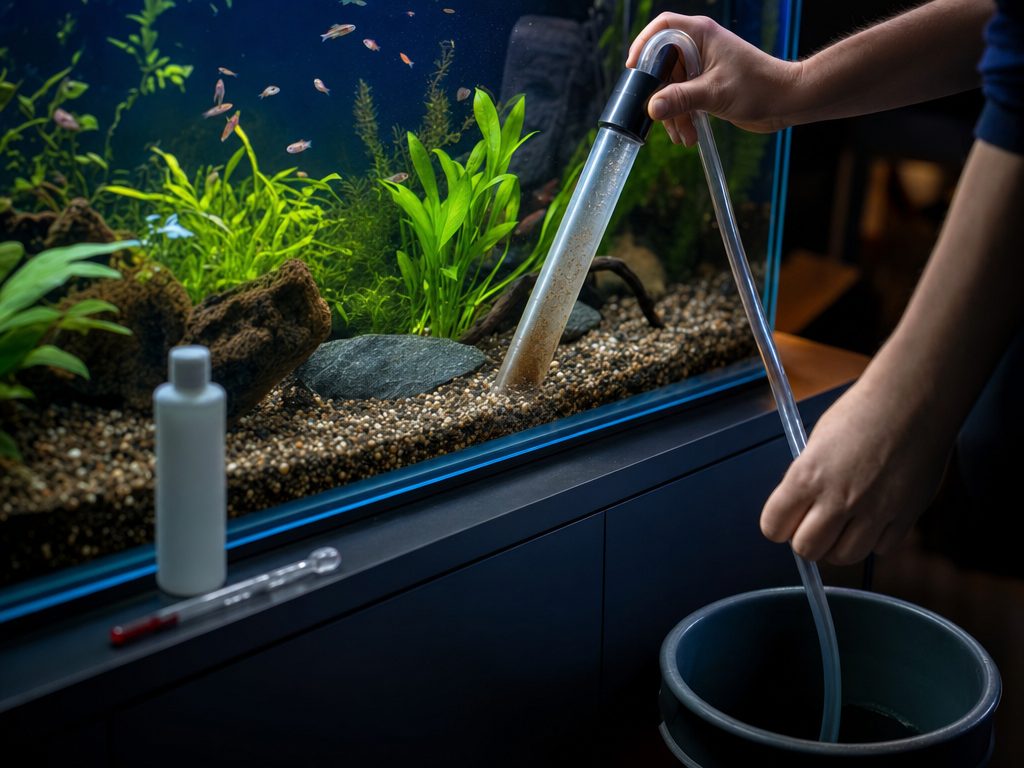
Waste turns into nitrate that most filters do not remove. Water changes take it out and put back minerals the fish use.
Most tanks do well with a 10 to 25 percent change every week or every other week.
If nitrate keeps climbing between changes, change water more often or a little more each time.
Crowded tanks and messy eaters such as goldfish or large cichlids usually need bigger or more frequent changes.
If it has been months, do several smaller changes over a week or two. One huge change can shift the water too fast.
Keep these tools for the aquarium only. Soap and cleaning residue from household buckets can harm fish.
A gravel vacuum is a wide tube on a siphon hose. Pick one sized to your tank.
Tap water often contains chlorine or chloramine. Both harm fish and filter bacteria.
Match new water to the tank within a degree or two. Do not guess by hand.
Mix new saltwater ahead of time in a clean container with a small pump and heater.
Have the new water ready before you remove anything. Then the tank is only low for a few minutes.
Turn off equipment that should not run in low water.
Keep the bucket lower than the tank. Start the flow with the bulb or by filling the tube underwater.
Push the tube into the gravel, let the dirt lift, then move to the next spot before gravel climbs the tube.
Add conditioned, temperature-matched water slowly so you do not blast the substrate.
Not every bottom should be dug into. Match the technique to what is in your tank.
Hover over the surface and clean open areas. Digging into roots or nutrient soil clouds the water and disturbs plants.
Hold the tube about an inch above the sand. Debris lifts while the heavier sand falls back down.
Siphon only the surface of reef sand. Digging deep into an old sand bed can release trapped waste.
Evaporation leaves minerals and salt behind. Top off saltwater tanks with fresh RO/DI water, never saltwater.
Water changes are safe when the new water matches the old. Most problems come from skipping that step.
Even a small amount of untreated tap water can stress fish and harm filter bacteria.
Water that feels fine to your hand can be several degrees off. Use a thermometer.
A deep gravel clean and a filter clean on the same day removes a lot of bacteria. Space them out.
Fresh-mixed or unmatched saltwater can swing salinity and pH. Mix ahead and check it first.