The Hidden Reef home
Help Center / pH Swings
Water chemistry guide

pH Swings

A steady pH matters more than a perfect number. Most swings come from low buffering (KH in freshwater, alkalinity in reef tanks), changes in CO2, or how you top off and change water. Find the cause before you add a pH product.
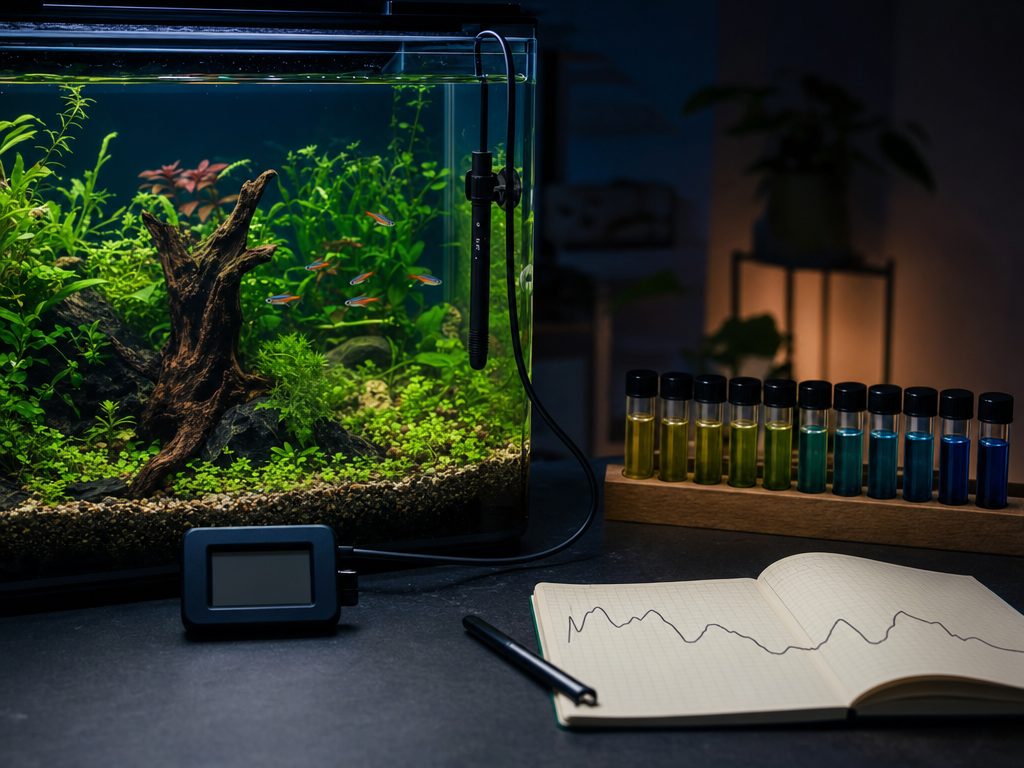
Aquarium with a pH probe in the water, color test vials and a logbook charting readings over the day
Symptoms

Signs pH is not holding steady.

One odd reading is not a crisis. A pattern is.

  • A big morning-to-evening gap, larger than your tank's usual daily swing.
  • pH slowly sliding down between water changes, often in older freshwater tanks with low KH.
  • Fish stress after water changes: hiding, clamped fins, flashing, or fast breathing.
  • Fish breathing hard late in the day in planted tanks with injected CO2.
  • Pitted snail shells in freshwater, a sign of soft water with little KH.
  • Reef corals not opening while alkalinity readings bounce from test to test.

A small daily swing is normal. With plants, algae, or corals, pH rises while lights are on and falls overnight as CO2 builds. A few tenths over the day is common. Test at the same time each day.

  • Freshwater: many community fish do well around 6.5 to 7.5 if it holds steady. Livebearers and African cichlids like it higher; many tetras like it lower. Keep KH at about 3 to 4 dKH or more.
  • Reef: pH is roughly 7.8 to 8.4 with a daily swing. Pick an alkalinity target between 7 and 11 dKH and hold it steady.
  • Planted with CO2: pH drops on purpose while CO2 runs and recovers at night. It should follow the same pattern daily.
What to test first

Test the buffer, not just the pH.

pH is the result. KH, alkalinity, and CO2 are usually the cause.

Check
What you are looking for
If it is off
KH Freshwater.
Below about 3 to 4 dKH there is little buffer, and pH can drop quickly.
Raise it slowly with regular water changes or a KH buffer, a little each day.
Alkalinity Reef.
A steady number from 7 to 11 dKH. Shifts over about 1 dKH in a day stress corals.
Dose smaller amounts more often, and recheck how much your tank uses.
pH twice a day Before lights on and late in the light period.
This shows the size of your daily swing.
A swing bigger than your usual pattern points to CO2 or buffering.
Tap and top-off water Test what goes in.
Tap water pH can change after it sits overnight. Pure RO water has almost no KH.
In freshwater, remineralize RO water or blend it with tap.
CO2 system Planted tanks.
Bubble rate, timer, drop checker. CO2 should follow the light schedule, not run all night.
Lower the rate if fish breathe hard, and check the timer and solenoid.
Room air Reef tanks.
Low reef pH all day in a closed-up house, often in winter, can come from indoor CO2.
More surface movement and fresh air in the room often help.
Likely causes

What usually makes pH swing?

Find which fits your tank before you buy anything.

Freshwater

Low KH

Tank biology slowly uses KH up. Soft tap water, pure RO, driftwood, peat, and some plant soils lower it more. When it runs out, pH can crash.

Maintenance

Overdue water changes

Waste and acids build up, so pH sinks. A big water change then shifts it back fast and stresses fish.

Planted tanks

CO2 injection problems

A high bubble rate, no timer, or a regulator acting up as the cylinder runs low can drop pH sharply.

Reef dosing

Uneven alkalinity dosing

Missed doses, a whole day's dose at once, or running out of supplement makes alkalinity and pH seesaw.

Reef tanks

High CO2 in the house

A tightly closed home holds more CO2 in the air, which keeps reef pH low, often in winter.

Products

Chasing a number

pH up and down products wear off, and pH drifts back to where the buffer holds it. Each round adds a swing.

What to do today

Steady it slowly.

Pick the steps that match your tank. Change things over days, not hours.

1
Pause

Stop using pH up and pH down.

Put them away while you find the cause. Chasing the number adds swings.

2
Test and log

Test at the same times for a few days.

Record pH, KH or alkalinity, and ammonia. See tracking parameters.

3
Freshwater

Rebuild KH gradually.

Do smaller, more frequent water changes if your tap water has KH, or add a KH buffer a little at a time.

4
Planted

Check the CO2 setup.

Confirm the timer and drop checker, lower the rate if fish breathe hard, and add surface movement at night.

5
Reef

Steady the alkalinity.

Split doses through the day or use a doser. Raise low alkalinity about 1 dKH per day at most. See dosing basics.

6
Water changes

Match new water to the tank.

Bring new water close to tank temperature, pH, and KH, or salinity and alkalinity for reefs.

What to avoid

Fixes that cause bigger swings.

Fast corrections cause more trouble than a slightly off number.

Helpful supplies

Store departments that help.

Good testing and steady dosing do more than any pH bottle.

Testing

pH, KH, and alkalinity tests

Test the buffer along with the pH. Reefs need a reliable alkalinity test.

View testing
Monitoring

pH probes and controllers

A calibrated probe shows the full daily pattern, including overnight lows.

View controllers
Buffers

KH buffers and alkalinity supplements

Raise buffering slowly and hold it steady, rather than forcing a pH number.

View additives
Planted tanks

CO2 regulators and drop checkers

A solenoid on a timer and a drop checker keep CO2 on a steady schedule.

View CO2
Aeration

Air pumps and air stones

Surface movement lets extra CO2 escape, at night in planted tanks and in low-pH reefs.

View air equipment
Source water

RO/DI systems

Consistent water to start from. Freshwater tanks need minerals added back.

View R-O

When to bring a water sample or call

If pH keeps sliding after you raise KH, reef alkalinity will not hold steady, or fish are stressed or dying, bring a fresh water sample to the store with your tank size, livestock list, what you dose, and recent changes. A sample of your tap or RO water helps too.

Call (215) 269-4930 Visit the store