Dead spots
Where water barely moves, debris settles and breaks down. Cyano almost always starts there.
Red slime is not true algae. It is cyanobacteria, a bacteria that forms slimy mats where flow is weak and waste builds up. It is most common in reef tanks, but freshwater tanks get it too, where it is called blue-green algae. Remove it by hand, then fix the flow, light, and feeding habits behind it.
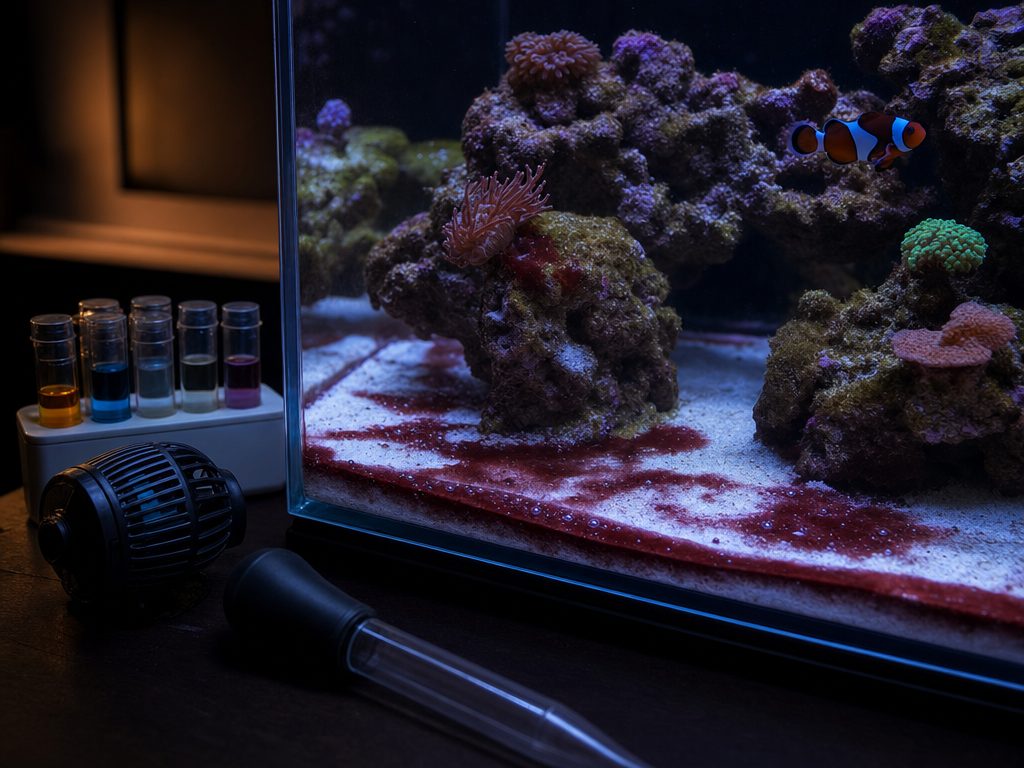
Cyano looks and behaves differently from algae. Check these signs first.
In freshwater, cyano is a blue-green or dark green slimy coat on gravel, plants, and decor. The fixes are the same, plus making sure plants are not starving for nutrients.
Cyano is a sign that something in the tank is off. These checks point to what.
Most outbreaks are two or three of these at once.
Where water barely moves, debris settles and breaks down. Cyano almost always starts there.
Uneaten food, frozen-food juice, and a heavy fish load add more nutrients than the tank can remove.
Socks, floss, and sponges left too long break trapped waste down and release it back into the water.
A poorly adjusted skimmer or skipped water changes let organics build up week after week.
Extra hours, window sun, or a sudden jump in intensity can tip the balance toward cyano.
Untreated tap water or spent RO/DI cartridges add phosphate and nitrate with every top-off.
Work in order. Expect it to fade over one to three weeks, not overnight.
Siphon the sand and use a turkey baster on rock. Removing it takes its nutrients out too.
Fresh socks or floss catch loose pieces before they settle. Change them again in a few days.
Aim a powerhead at the problem area. You want gentle movement across the sand, not a sandstorm.
Feed what fish eat in a minute or two. Thaw frozen food and pour off the liquid first.
Same schedule every day, no direct sun, and no sudden jumps in hours or intensity.
Log nitrate and phosphate to see if your changes work. See tracking parameters.
Quick fixes that skip the cause usually mean the mats return.
Pick tools that fix flow and export, not a bottle that hides the symptom.
Show where nutrients stand. Reef tanks need a low-range phosphate test.
View testingClear dead spots and keep debris moving toward the filter.
View wave makersFresh mechanical media catches loose cyano and waste during an outbreak.
View filtrationA well-sized, adjusted skimmer removes organics before they become nitrate and phosphate.
View protein skimmersClean top-off and change water stops you adding nutrients every week.
View R-OThe simplest cyano tool: lift mats out during every water change.
Shop maintenanceIf cyano keeps returning after two or three weeks of steady fixes, spreads onto corals, or fish breathe hard, bring a fresh water sample to the store with your tank size, livestock list, and recent changes. A clear photo helps tell cyano from dinoflagellates or diatoms.
Call (215) 269-4930 Visit the store