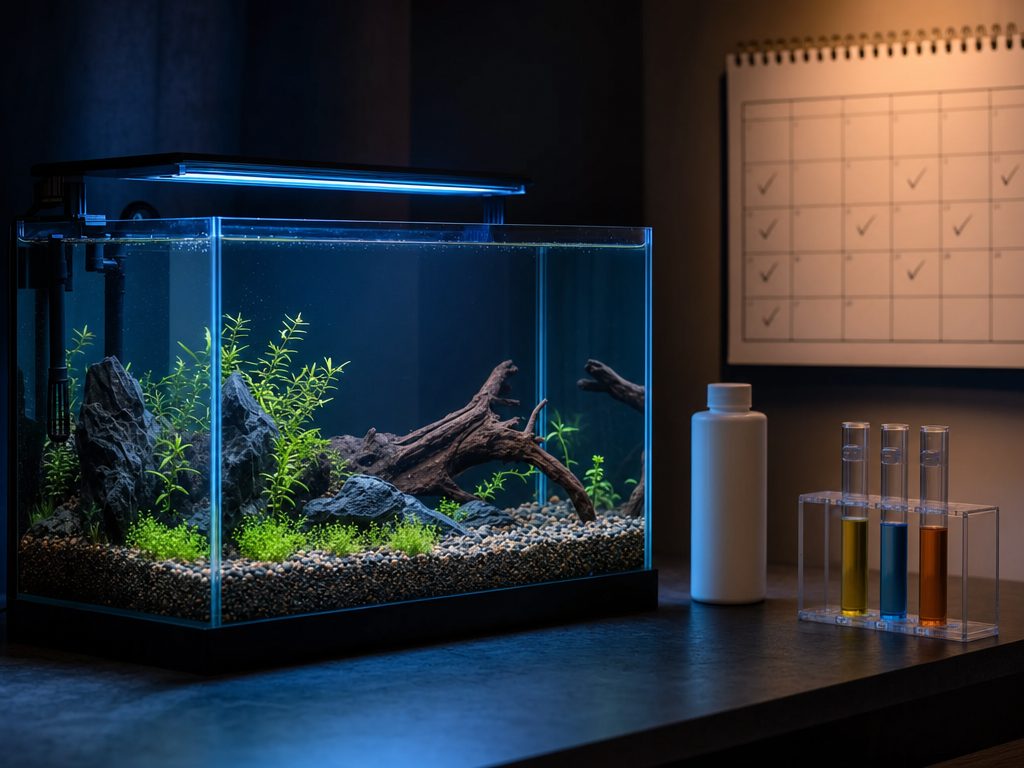
A new tank needs time to grow the bacteria that break down fish waste. Cycle it first, test as you go, and add fish slowly once the readings prove the filter is ready.
Helpful bacteria live on surfaces, mostly in the filter media, not floating in the water. Cycling means growing enough of them to keep up with the waste.
Stage 1
Ammonia
Fish waste, leftover food, and rotting plant matter release ammonia. In a brand-new tank, nothing removes it yet.
Toxic to fish even at low levels
More harmful at higher pH and temperature
Any reading above zero with fish present is a warning
Stage 2
Nitrite
One group of bacteria turns ammonia into nitrite. Nitrite is also toxic to fish.
Usually climbs as ammonia starts to fall
Makes it harder for fish to carry oxygen
Often the slowest stage to clear
Stage 3
Nitrate
A second group of bacteria turns nitrite into nitrate. Nitrate is much less toxic, but it builds up over time.
Rising nitrate means the cycle is working
Regular water changes keep it in check
Live plants use some of it as food
Saltwater too
Same cycle, more to watch
Saltwater tanks cycle the same way. The ready test is the same too.
Keep salinity steady for the whole cycle
Uncured rock can release extra ammonia as it settles in
Expect it to take as long as a freshwater cycle, or longer
Pick a method
Fishless, fish-in, or a head start
Fishless cycling is the safest choice because no animal lives through the toxic stages. Always treat tap water with conditioner first, since chlorine and chloramine kill bacteria.
Safest
Fishless cycling
You feed the bacteria an ammonia source with no fish in the tank. It commonly takes about 4 to 8 weeks.
Use pure ammonia with no soap, scent, or dye, or a pinch of fish food
Dose to about 2 ppm on your test kit, then redose when it drops
Keep the heater, filter, and lights on a normal schedule
Harder on fish
Fish-in cycling
A few hardy fish supply the waste. It can work, but they are exposed to ammonia and nitrite while the filter catches up.
Start with very few small, hardy fish
Feed lightly and test every day or two
Change water whenever ammonia or nitrite reaches about 0.25 to 0.5 ppm
Head start
Bottled bacteria
A bacteria starter can shorten the wait in some tanks. Results vary, so trust your tests, not the calendar.
Add it after the water conditioner, not before
Follow the label for amount and timing
The bacteria still need an ammonia source to grow
Head start
Seeded media
A used sponge or bio media from an established, healthy tank already carries live bacteria.
Only take it from a tank with no disease or pest problems
Keep it wet and move it quickly
Keep testing: it speeds the cycle up but does not skip it
Week by week
What the test readings look like
This is a typical fishless cycle. Your timing will be different, but the order of events is usually the same. Write every result down.
Week 1
Ammonia only
Ammonia reads high after each dose. Nitrite and nitrate stay near zero. It looks like nothing is happening.
Test every few days
Do not clean or replace the filter media
Be patient: the bacteria are just getting started
Weeks 2-3
Nitrite shows up
Ammonia starts to drop faster. Nitrite rises, sometimes past the top of the color chart.
Keep redosing ammonia when it falls
Check pH: the cycle uses up buffer, and very low pH can stall it
If nitrite stays off the chart for a long time, a partial water change can help
Weeks 3-6
Nitrate climbs
Ammonia clears within a day of dosing. Nitrite starts to fall and nitrate keeps rising.
You are close, but not finished
Keep dosing the same amount
Nitrite is often the last reading to reach zero
Done
Zero and zero in 24 hours
You dose ammonia, and within 24 hours both ammonia and nitrite read 0 while nitrate is present.
See the same result several days in a row
Do a large water change to lower nitrate before fish go in
If fish are delayed, keep dosing so the bacteria do not shrink
After the cycle
Stock slowly and avoid these mistakes
A cycled filter is sized to the waste it was fed. Add fish in small groups so the bacteria can grow along with the load.
Stocking
Add a few fish at a time
Start with a small group of hardy, compatible fish. Wait one to two weeks, test, and add more only if ammonia and nitrite stay at zero.
Mistake
Trusting the calendar
A tank is not cycled because it has run for a week. Only test results tell you it is ready.
Mistake
Cleaning away the bacteria
Rinsing media in tap water or swapping all of it at once can restart the cycle. Rinse in removed tank water instead.
Mistake
Overfeeding new fish
Extra food becomes extra ammonia. Feed lightly for the first few weeks and test every few days after each addition.